

How to Stay Productive Working From Home With Kids: 12 Science-Backed Strategies
Real solutions for real parents. No toxic productivity hacks—just proven methods that actually work in 2024.

Remote work allows parents to spend 2.4 additional hours daily with their children compared to office-based parents. [^3^]
Let's be brutally honest: working from home with kids is like trying to type with one hand while catching flying spaghetti with the other. It's messy. It's chaotic. And somehow, 22.9% of American workers are figuring it out right now. [^11^]
Here's what nobody tells you: you don't need perfection. You need survival systems. The parents who thrive aren't superhuman—they're strategic. They understand that remote work with children isn't about replicating office productivity; it's about redefining what productivity looks like when your "coworker" demands snacks every 12 minutes.
📋 Quick Navigation
The Reality Check: What the Numbers Actually Tell Us
Before we dive into solutions, let's look at the hard data—because understanding the battlefield helps you win the war.
📊 The State of Remote Parenting in 2024
Here's the paradox: remote workers are both more distracted AND more productive. Studies show remote employees dedicate 59.48% of their workweek to focused tasks—over ten percentage points more than office workers. [^28^] The secret? Remote workers get 273 minutes of uninterrupted work daily versus 223 minutes for office staff. [^28^]
But—and this is crucial—kids change the math. When children enter the equation, that uninterrupted time evaporates faster than free coffee in a break room.
🎯 Top Distractions for Remote Working Parents
Source: SellCell Survey 2021 [^7^] | Note: Data reflects general remote worker distractions; parents experience kids as primary disruptor
Why Remote Work With Kids Matters More in 2024
The landscape shifted dramatically. Between 2019 and 2023, nearly one million mothers moved from in-person to remote work. [^3^] This isn't a temporary blip—it's a structural transformation of how American families operate.
The financial reality is stark: In 2024, parents spend an average of 24% of household income on childcare. The US government defines "affordable" as 7%. [^23^] Remote work isn't a luxury for many parents; it's the difference between financial stability and drowning in daycare bills.
12 Battle-Tested Strategies for Productive Remote Parenting
1. The "Split Shift" Survival Method
Stop trying to work 9-to-5. It doesn't work with kids, and pretending it does creates burnout.
The strategy: Work 6:00 AM to 9:00 AM before kids wake up. Handle morning routines. Work again 10:00 AM to 2:00 PM while kids are at school or daycare. Stop for pickup and afternoon activities. Final 1-2 hour block after bedtime. [^1^]
Total: 8 hours of work, zero missed moments. This isn't idealistic—it's how Deshawn, a single dad of two elementary kids, actually operates: "I work 8:30 AM to 2:30 PM while the kids are at school, handle pickup and homework, then do a final 90-minute block after bedtime. The days I can walk my kids to school and still hit my deadlines? That's worth everything." [^1^]
2. Visual Boundaries, Not Just Verbal Ones
Kids don't process "I'm working" the way adults do. They need visual cues.
Create physical signals: a specific hat, a sign on a chair, masking tape on the floor marking your "office zone." [^1^] When Priya and her husband both shifted to remote roles with two preschoolers, they used the "tag team" method—one parent works 7 AM to 1 PM while the other covers kids, then they swap. "The first week was chaos. By week three, we had it dialed. The kids actually liked knowing whose 'shift' it was." [^1^]
3. The "Interruption Protocol" for Older Kids
Kids as young as five can follow color-coded systems:
- Green sticky note: "Come in for emergencies only"
- Red sticky note: "Come back in 30 minutes unless the house is on fire"
- Yellow sticky note: "Check in quietly in 15 minutes"
This teaches boundaries while keeping safety intact. [^1^]
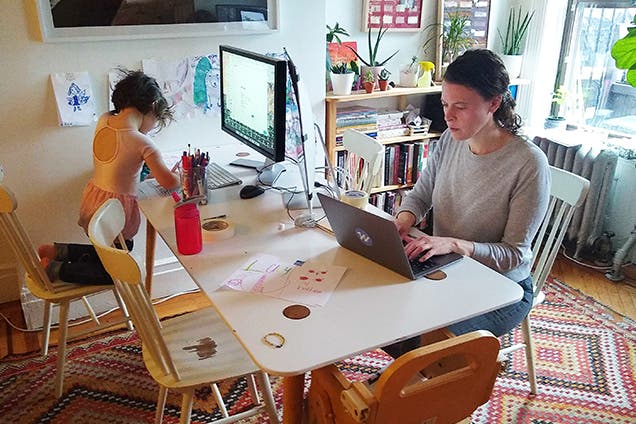
Creating designated workspaces helps children understand boundaries while allowing supervised proximity. Photo: Wirecutter/NYT
4. Front-Load Your Brain Power
Your sharpest thinking should happen during your most uninterrupted block. For most parents, that's early morning before the house wakes up, or the first hour after school drop-off. Protect that block ruthlessly. [^1^]
Research from the Bureau of Labor Statistics confirms that employed parents with children under 6 spend almost an hour less in leisure activities than non-employed parents, precisely because they're front-loading work during quiet hours. [^2^]
5. Batch Meetings Like Your Sanity Depends On It (Because It Does)
Request that recurring meetings cluster on two or three specific days. "Meeting-free days" aren't a productivity trend—they're a survival strategy for parents who need unbroken childcare-free blocks. [^1^]
According to Hubstaff data, remote workers already have fewer interruptions than office workers, but parents need to be militant about protecting focus time. [^4^]
6. The Backup Plan Rule
Identify two people you can call if childcare falls apart: a neighbor, a grandparent, a friend with compatible-aged kids. Cooperative babysitting swaps cost nothing and save careers. [^1^]
Here's the reality: 28% of home workers have been distracted by a crying child during a work call. [^29^] Having backup isn't weakness—it's professional risk management.
7. Communicate Proactively (Don't Ask, Inform)
Tell your manager: "I'm offline from 3:00 to 4:30 for school pickup. I check messages at 4:30 and respond to anything urgent." You're stating your workflow, not asking permission. [^1^]
This approach aligns with findings that 75% of mothers and 93.7% of fathers with children under 18 are in the workforce—you're not a niche demographic asking for special treatment, you're nearly half the labor force. [^1^]
8. The "Always Available" Trap (Avoid It Like the Plague)
Remote-working parents face a specific danger: compensating for flexibility by being perpetually online. The guilt of leaving a meeting early for a pediatrician appointment leads to answering Slack messages at 10 PM to "prove" commitment. This destroys the exact benefit remote work is supposed to provide. [^1^]
9. Document Your Output (Make Your Work Visible)
Set a hard shutdown time and communicate it. Block your calendar after that time. Turn off notifications. The antidote to "always on" isn't working more hours—it's delivering visible results during working hours. [^1^]
Share wins in standups. Write clear weekly summaries. Your work should speak louder than your green status dot.
10. Create a "Sensory Switch" for Mode Changes
When you're the only adult, the line between work and home dissolves instantly. Build start-up and shut-down rituals: making specific coffee before work, closing the laptop with a specific phrase, changing clothes. [^1^]
These rituals create neurological boundaries that your brain recognizes even when no one else enforces them.
11. The 20-Minute "Transition Buffers"
Never schedule work meetings to end exactly when kids need attention. Build 20-minute buffers between work blocks and parenting blocks. This prevents the "frantic handoff" that leaves both work and kids feeling neglected.
12. Embrace "Good Enough" Parenting During Work Hours
Screen time limits bend during deadlines. Nutritional perfection wavers. The kids will survive. Research on working from home shows that children of remote-working parents actually show educational gains—particularly in math and reading scores—when parents have flexible schedules. [^8^]

Independent play near parents helps children develop autonomy while allowing work focus. Photo: Kids Eat in Color
Three Schedule Templates That Actually Work
Template A: The School-Age Sprint (Kids 6+)
- 6:00-8:30 AM: Deep work (kids asleep/getting ready)
- 8:30-9:00 AM: School dropoff
- 9:00-2:30 PM: Core work block
- 2:30-4:00 PM: Pickup, snacks, homework help
- 4:00-5:30 PM: Light tasks/email
- 8:00-9:30 PM: Final work block (if needed)
Template B: The Preschool Pivot (Kids 3-5)
- 5:00-7:00 AM: Deep work
- 7:00-9:00 AM: Morning routine
- 9:00-12:00 PM: Work (with interruptions)
- 12:00-2:00 PM: Lunch + quiet time/nap
- 2:00-4:00 PM: Meetings only (kids often awake)
- 8:00-10:00 PM: Catch-up work block
Template C: The Baby Balancing Act (Under 2)
- 5:00-7:00 AM: Critical work
- 9:00-11:00 AM: Work during morning nap
- 1:00-3:00 PM: Work during afternoon nap
- 8:00-10:30 PM: Primary work block
- Weekends: 2-3 hours Sunday evening prep
The Honest Limitations (Let's Get Real)
Not every strategy works for every family. Here are the hard constraints:
Single parents face amplified challenges. Every difficulty listed above happens with half the backup. Research from King's College London found that when remote work policies target mothers specifically, managers perceive remote workers as less committed—creating career penalties. [^12^] Universal flexibility policies reduce this stigma. [^12^]
Some roles resist remote optimization. Jobs requiring constant video presence, rigid client hours, or immediate response times don't bend easily around childcare. If you're in customer service with back-to-back calls, these strategies have limits.
Kids get sick. Schools close unexpectedly. The backup plan fails. On these days, "productivity" might mean answering three emails. That's okay. The annual average still works out.
The research is mixed on long-term career impact. While 79% of managers feel their team is more productive when working remotely, [^24^] 87% of CEOs might give better jobs or raises to those who come to the office. [^22^] The data suggests remote work neither hindered nor helped aggregate productivity growth across industries. [^27^]
Video: Practical Tips from Remote Work Experts
J.D. from GitLab shares actionable strategies for remote working parents. GitLab operates as a fully remote company with extensive experience in distributed work.
FAQ: Real Questions from Real Parents
Related Resources
Looking for more strategies on managing digital wellness while working remotely? Check out our guide on maintaining mental clarity in a connected world over at MindUnplug. For additional time management techniques that complement remote parenting, explore their resources on digital detox strategies for busy professionals.
🚀 Ready to Transform Your Remote Work Experience?
Working from home with kids isn't about achieving perfection—it's about building sustainable systems that honor both your professional ambitions and your parenting priorities.
Start with one strategy. Just one. Master it this week. Add another next week. Within a month, you'll have a custom system that actually fits your life.
Pick Your First Strategy📚 Sources & References
This article synthesizes data from the U.S. Bureau of Labor Statistics, Pew Research Center, King's College London, National Bureau of Economic Research, and peer-reviewed productivity studies. All statistics reflect 2024 data where available. For specific citations, see inline references throughout the text.
Key Studies Referenced: American Time Use Survey 2024, Hubstaff Remote Work Report, SellCell Remote Work Distraction Survey, Institute for Family Studies Analysis, King's College London Gender & Work Organization Research.
Last updated: November 2024. Data reflects US workforce statistics.



0 Comments